

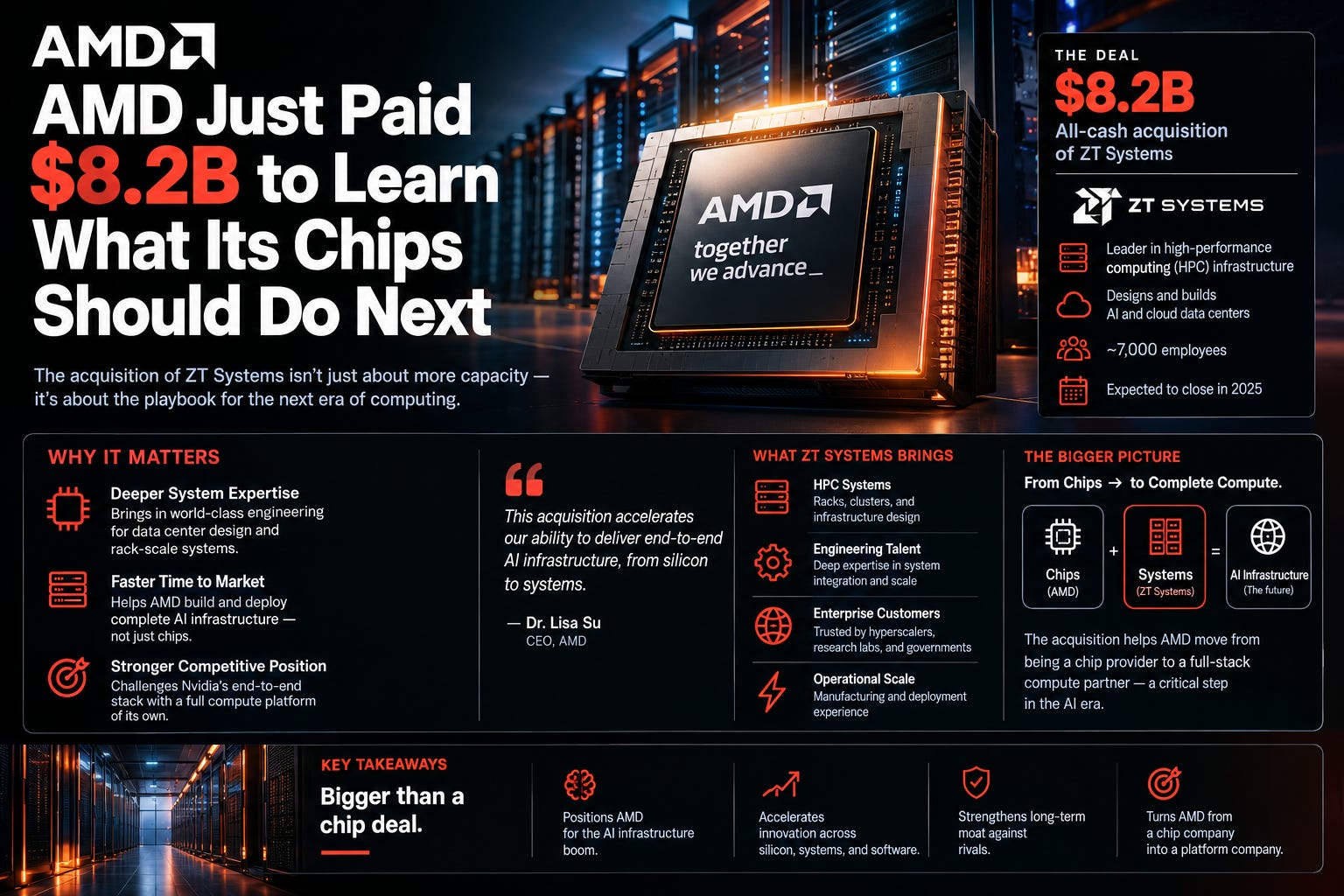
A month ago, World Labs was reportedly talking about a $5 billion valuation. On Monday, AMD agreed to buy it for $8.2 billion in stock.
That’s not a startup exit. That’s a chip company deciding it can’t win the next round of AI from the outside looking in.
The deal
World Labs, founded by Stanford professor and ImageNet creator Fei-Fei Li, builds “world models.” These are AI systems that generate and simulate interactive 3D environments from text, images, or video. Its Marble product creates simulated worlds used for entertainment and for training robots.
Here’s what’s been reported:
Price: About $8.2 billion, all stock, per Axios and Quartz.
Timing: Expected to close by the end of 2026, subject to regulatory approval.
Leadership: Li becomes AMD’s executive vice president and chief scientist, reporting to CEO Lisa Su. Co-founders Justin Johnson and Ben Mildenhall keep running the World Labs team.
Funding history: World Labs came out of stealth in 2024 at a valuation above $1 billion, backed by Andreessen Horowitz, NEA, and Radical Ventures. Its latest round raised $1 billion from a group including Nvidia, AMD, Autodesk, and Fidelity.
Existing ties: The two companies already had a training and inference partnership, and World Labs was training models on AMD GPUs.
Read that investor list again. Nvidia backed the startup its biggest rival just bought.
The mental model: Circle of Competence
Know where your edge ends, and be honest about it.
AMD’s circle is silicon. Nvidia’s advantage has never been only chips. It’s the software, the developer tools, and its own world-model suite, Cosmos. Nvidia understands the workloads before they arrive, so it builds hardware for where AI is going.
Lisa Su said it plainly: building compute for the next generation of AI requires deep understanding of how models evolve. Translation: AMD knows the edge of its circle and is buying its way past it.
That’s the smart move. A company that stays inside its circle forever gets commoditized. A company that pretends its circle is bigger than it is makes expensive mistakes.
The second risk is the one I’d watch. Chipmakers have bought AI teams before. Intel acquired Nervana in 2016 and later wound down that product line in favor of Habana. Buying a lab doesn’t mean you know how to run one.
Spence’s take
The headline is the price. The story is the feedback loop.
World models are compute-hungry, and robotics is where physical AI gets real. If World Labs’ workloads shape AMD’s chip roadmap, AMD gets something Nvidia has had for years: a front-row seat to what the next models need.
Here’s the contrarian part. The biggest risk isn’t overpaying. It’s over-owning. Research labs run on independence. If World Labs becomes an internal AMD project, it could lose the external users and talent that made it valuable.
Three signals I’m tracking: whether Johnson and Mildenhall stay past the first year, whether Marble stays usable on other companies’ hardware, and whether regulators scrutinize a chip company owning a foundation model.
Buy the capability. Protect the culture. That’s the whole game.
If this was useful, share it with someone who builds things. And if you want the full toolkit of 50 mental models, you can grab my book, Mental Models: How to Think, Act, and Win, on Amazon right now.
Disclaimer: This post is for informational and educational purposes only and is not investment, legal, tax, or financial advice. Nothing here is a recommendation or solicitation to buy, sell, or hold shares of AMD, Nvidia, or any other security. Deal terms, funding history, and valuations are as reported by TechCrunch, Axios, Quartz, and Tech Funding News (September 28 and 29, 2026) and have not been independently verified. The approximately $5 billion figure was reported by third parties and was not confirmed by World Labs. The transaction is subject to regulatory approvals and other closing conditions and may not close as announced. Statements about what the deal could mean reflect the author's opinion and are forward-looking, uncertain, and subject to change. Always do your own research and consult a qualified professional before making any financial decision.
If you want the mental models behind breakdowns like this, my book, Mental Models: How to Think, Act, and Win, is on Amazon now.


This post is for informational and educational purposes only. It is not investment advice, a recommendation, or a solicitation to buy or sell any security. Funding figures, revenue, and valuation are as reported by the company, regulatory filings, and named outlets; the ~$470M valuation is a reported, time-sensitive snapshot and not independently verified. Dhoni's individual investment amount was not disclosed. The /mkt reference is a structural illustration of building in regulated markets and is not an offer or solicitation. Past performance and third-party investment decisions do not indicate future results.